
Updated: December 2025
Introduction
For many families in Michigan, probate quickly centers around one thing: the home. It may be the place where generations grew up, or it may be filled with decades of belongings from a loved one’s final years. Either way, it is often the estate’s largest asset—and the most emotional to manage.
Selling a home in probate isn’t just about paperwork and contracts. It’s about protecting value, preserving what matters, and honoring a legacy while navigating a court process that demands precision. Unlike bank accounts or vehicles, real estate is immovable. It requires court authority to sell, proper handling by the personal representative, and care to ensure heirs receive the most from what was built.
This is where families often feel stuck. Probate homes carry unique challenges:
- Authority Layer: Only the court-appointed representative can sell.
- Emotional Layer: The home is full of memories, not just square footage.
- Legal Layer: Every step must follow probate rules, with timelines and paperwork that feel heavier than a traditional sale.
- Responsibility Layer: Executors must protect the home’s value for all heirs, not just act as though it’s any other listing.
Here’s the deal: we’re not attorneys, and this guide isn’t meant to cover every detail of probate law. Our expertise is real estate—the place where most estates either keep their momentum or stall out. This guide exists to bring clarity to the property side of probate, where families have the most at stake and the most to protect.
In this guide, you will learn:
- The one repair mistake that drains thousands from heirs’ inheritance — even when the home sells for more.
- How to spot when selling as-is actually nets more than fixing and why certainty beats a “theoretical” higher price every time.
- The hidden burn rate every probate executor must calculate: how each unsold month silently erodes inheritance, dollar by dollar.
- Probate real estate’s #1 success lever: why the right price + speed combo protects families better than fancy marketing promises.
- The simple 7/14/21 day rule to know if your listing is on track — or quietly turning stale online (costing the estate thousands).
- Why choosing the wrong realtor in probate can sabotage the estate — and the exact qualities to demand before you trust anyone with the home.
Basics of Michigan Probate
Probate is the term used to describe the legal process of settling a person’s estate after they pass away. In its simplest form, probate is making sure assets are accounted for, handled properly, debts are paid, and remaining proceeds are distributed to heirs or beneficiaries according to a valid will or Michigan laws.
The process begins when someone, usually a family member or executor, files the necessary paperwork to open up probate and move toward an appointed personal representative. A Michigan executor has several duties, such as opening probate, notifying creditors, gathering assets, verifying claims, and distributing what’s left of the estate.
Now, there are a lot of different aspects to know about probate, such as simplified estates, informal versus formal probate, and the maze of forms and filings.
A home is usually the single largest asset in the estate, and it’s often the factor that kills an estate’s momentum or limits what heirs actually receive. That’s why this guide zeroes in on the property side of probate—the place where families have the most at stake and the most to protect.
However, want more information about Michigan probate? We created some excellent guides and video interviews by partnering with Michigan probate attorneys. In that article, you will also find our analysis on 2025 Ingham County probate attorney and law firm data.
- Jargon-free, plain definitions of probate
- What does an executor in Michigan do?
- How much does Michigan probate cost?
- How long does Michigan probate take?
Want to go even deeper and more focused? Check out some of our hyper-local probate guides:
Do We Need To Sell?
The family home carries a weight that goes beyond bricks and beams. A house may be built of wood and drywall, but a home is built of memories, shared stories, and legacies. It’s built from holidays around the table, laughter in the backyard, quiet moments that shaped the family’s story.
As a result, there is a natural pull to hold on to the family home, even when probate forces difficult financial decisions.
Despite the emotional depth the family home carries, probate comes down to practical realities. Courts and creditors don’t measure memories and feelings. They measure dollars.
For the estate to keep the home, there must be enough liquid assets to cover debts, taxes, and administrative costs. If the estate is short on cash, the funds may have to come from the heirs themselves.
Even if there is enough cash, family dynamics and competing priorities may require further cash to buy out other heirs or beneficiaries to the estate.
Whether or not you can keep the home is going to depend on:
- What the Will says
- Financial situation and creditors
- Family dynamics
For a deeper dive into whether a sale is required, see our full article: Do We Have to Sell the House in Probate?
If a Sale Is Required, Timing Matters
If the estate does need to sell the home, the next question is when that sale should occur.
In Michigan, a probate home may be sold during probate, while the estate is still open and supervised by the court, or after probate closes, once the property has been distributed and becomes an inherited home.
Each option carries different implications for control, timing, taxes, family dynamics, and responsibility. Understanding those differences can help families make decisions that reduce stress and avoid surprises.
To understand how selling during probate compares to selling after probate, and how those choices fit into estate settlement as a whole, see: When Should You Sell a Probate or Inherited Home?
Wait For Authority to Sell The Probate Home
One of the most common mistakes in probate is taking action on the estate before the proper authority has been granted. What “authority” means depends on the probate process.
The court appoints a personal representative (sometimes called an executor), and only that person has the legal power to act on behalf of the estate. In some cases, the will or court order clearly defines their responsibilities. In others, there is more room for discretion—but the principle remains the same: without authority, no one can legally sell a probate home in Michigan.
That means you cannot sell a home before probate if the home should be included in probate.
Listing a probate home isn’t as simple as putting a sign in the yard. Entering into a listing agreement is a legal contract, and that’s the point where probate law and contract law intersect.
The personal representative must have proper authority, and the contract itself must follow probate-specific rules. Missing those details can stall the sale—or worse, make the agreement unenforceable.
While you cannot enter into a listing agreement yet, it’s a good idea to begin bringing in a probate real estate agent to help with certain decisions, such as what repairs (if any) to make and what the home may sell for.
Secure & Protect The Probate Home
Protecting the estate’s assets, such as the home, is one of the most important duties of a Michigan executor. It’s important to protect and secure the home.
In an obvious sense, it means changing locks and providing access to only those you trust. More importantly, it means making sure the real estate holds value so heirs don’t lose proceeds to preventable mistakes.
Tasks under this category include:
- Securing the home immediately (locks, alarms, inspections).
- Maintaining appearances (lawn care, snow removal, mail collection).
- Documenting expenses (so costs can be reimbursed from the estate).
- Updating insurance to make sure coverage matches the property’s vacant status.
A vacant home can quickly become a liability. Overgrown lawns, piled-up mail, or broken windows send signals that the property isn’t being cared for, inviting trespassers, fines, or damage.
Inside, unchecked leaks or frozen pipes can cause thousands in repairs, shrinking what heirs ultimately receive. Insurance may also lapse or limit coverage once a property sits empty for 30–60 days unless updated to a vacant-home policy.
What seems like a small oversight can reduce the home’s market value, cut into proceeds, and prolong the probate process.
Valuing The Probate Home
The process of valuing a probate home depends on the reason you need the valuation. When it comes to a probate home, there are several reasons you need a valuation.
- Tax purposes and a step-up basis (required by the IRS)
- Court orders
- Heirs contesting the estate
- Selling a probate home
Each situation has an acceptable method of home valuation and date of valuation.
- Tax and IRS Requirements: A single, accurate number is important for tax and IRS purposes. For that reason, the IRS needs a date-of-death valuation by a Michigan licensed appraiser.
- Probate Process: Depending on the probate process you find yourself in, you may need the expertise of a licensed appraiser or pricing strategy advisor real estate agent.
- Selling The Home: Use a real estate agent with a pricing strategy advisor certification in order to price the house appropriately. These are specific agents with extra qualifications in valuing real estate.
In most tax and legal cases, it is preferred to use the date-of-death valuation. This represents the value of the home at the time of death.
The concept can get confusing and is easiest to understand when looking at stock or cash assets. For stocks and cash, you can look back at the balance on the date of death.
It works the same way for a probate home.
If curious how home values are determined, you can read our article written for real estate agents on how to do a comparable market analysis.
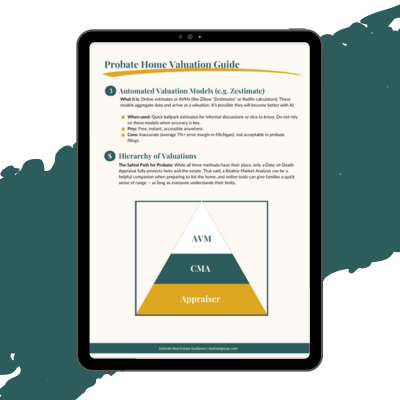
Not Sure What Your Probate Home Is Worth?
Read our free 3 home valuation guide that explores the three different valuations methods and which ones hold up in court, with the IRS, or selling the property.
Prepare The Home For Sale (Maybe)
Most probate homes are full of belongings and memories that need to be handled.
The process of preparing the home can be done once legal authority is established and doesn’t have to wait until the home’s valuation is determined. It’s important to understand when you can start emptying a house in probate.
To clear the home, you will need to:
- Divide personal belongings according to the Will or preference
- Conduct an estate sale for any remaining or disputed items
- Donate any remaining items
- Hire a junk removal company
Once the home is cleared, it’s a good idea to hire a professional local cleaning company.
Make Repairs or Sell As-Is for Probate?
The first instinct many families have is to fix up the home so it sells for more. It’s a natural thought, but in probate and any inherited home, the question isn’t whether the repairs can raise the price — it’s whether they increase the net proceeds after costs and risks.
Probate homes are not like traditional listings. They’re often dated, untouched for years, and filled with decades of belongings. Kitchens may have never been remodeled, bathrooms may feel frozen in time, and mechanical systems may be far beyond their expected life.
Unlike typical sellers, estates don’t have ready cash to fund major updates. Every dollar spent must come from estate assets or heirs’ pockets, and those decisions impact everyone’s inheritance. That reality makes the repair question more complex than simply asking, “Will the house sell for more?”
Focus on net profit, not sales price. This is a very different mindset than most agents.
The decision to make a repair or remodel involves direct-costs, carrying costs, capital, and risk. All of these elements must be accounted for when deciding on whether to make a repair. Here is the proper lens executors need to evaluate repairs:
- Return on Investment (ROI): Does the work add more than it costs?
- Holding Costs: How much will taxes, insurance, and utilities cost during the delay?
- Risk: What happens if contractors uncover bigger problems?
Even if you manage to calculate a positive return on investment, it often evaporates in practice once you factor in time, uncertainty and the various factors of risk.
Together, these risks reduce what we call the risk-adjusted return. What looks like a gain on paper can evaporate in practice once you factor in time, risk, and uncertainty.
Why As-Is Often Wins
For most families, especially in probate, the optimal solution is to sell the home as-is. Here’s why:
- It eliminates holding costs and gets the estate liquid sooner.
- It reduces the chance of disputes over what to fix, how much to spend, and who should decide.
- It avoids the risk of pouring money into updates that may not deliver a positive return.
Sometimes, it is actually wiser to accept a slightly lower sale price today if it means the estate receives the money with near certainty. A guaranteed net return, even if smaller, often beats a theoretical higher return that may never materialize.
Repairs and updates can sometimes lift a property’s sale price, but in probate, higher price doesn’t automatically mean higher profit. With added risk, delays, and holding costs, most families are better served by a straightforward as-is sale.
Pick A Selling Method
We established that selling the property as-is is often the best bet for the estate. The next decision you have to make is whether to sell it through a cash-buyer real estate company or a traditional real estate agent.
Both methods have their pros and cons, as well as risks and things to watch out for.
Selling Probate Home to Cash Buyer
Cash buyers — often real estate investors — are a quick path to selling a home in probate. These types of buyers and companies will purchase the home quickly with no financing or inspection contingencies.
This is a great option for an estate looking for liquidity and speed. Here are some of the benefits of a cash buyer:
- Speed: Closings beat the market and often occur in weeks, not months. You may not even need to clear out the belongings.
- Greater Certainty: No mortgage approvals or appraisal issues to derail the deal.
- Convenience: Minimal prep; often no clean-out required.
Of course, what is gained in speed, certainty and convenience comes at the cost of sales price.
Since cash buyers assume the risk and intend to profit from the resale, they purchase the property below market value. It creates a feeling of “giving away” the home for less than it’s worth.
However, an estate may come out ahead on cash buyers when you consider carrying costs and the length of probate.

List A Probate Home With A Realtor
The most common path is a traditional listing with a probate-experienced realtor. This balances exposure to the full market with guidance on pricing strategy.
A qualified agent can help the executor weigh whether minor touch-ups are worthwhile, whether to market as-is, or whether cash buyers should be considered alongside open-market offers.
Key elements of traditional listing:
- Valuation: Use a Pricing Strategy Advisor (PSA) or licensed appraiser for accuracy.
- Marketing: Even as-is homes deserve professional photos and thoughtful presentation.
- Disclosure: Probate requires specific contract terms—an experienced probate realtor will ensure compliance.
Hire A Probate Real Estate Agent
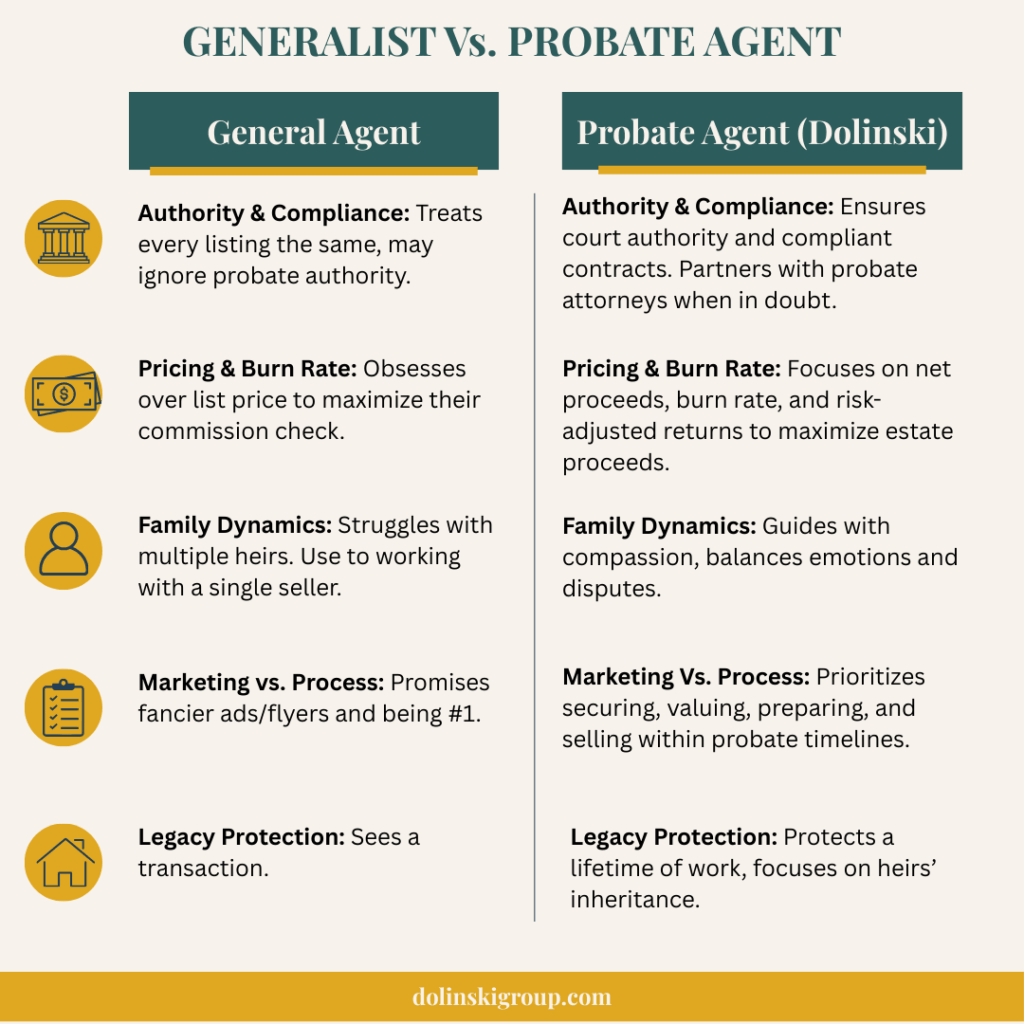
The family home represents the lifetime work and legacy of a loved one. It’s too important to leave it to any real estate agent.
It’s easy to assume that selling a home is selling a home. If someone holds a real estate license, they must be qualified and have the skills to handle a probate transaction. This belief is a costly mistake.
In Michigan, the bar to get a real estate license is remarkably low. After just a short course and an exam, anyone can call themselves an agent. That means a new licensee with little experience could be entrusted with the most complex type of sale you’ll ever face: a probate home.
What to Look For in a Probate Realtor
- Specialization: Certifications like Pricing Strategy Advisor (PSA) or probate-specific training.
- Communication: Clear, documented communication with executors, heirs, and attorneys.
- Problem-Solving Skills: Ability to handle disputes, negotiate fairly, and keep the process moving.
For more tips, read our guide to finding a probate real estate agent.
Does My Agent Need Certifications?
If you dig around for a probate-specific real estate agent, you may find some companies offering certifications or see agents with certifications.
You’ll see initials like CPRES or MTI Probate Specialist. These letters look official, but here’s the truth: they carry no real weight in the probate process.
Unlike legal designations (like a licensed attorney or CPA), probate certifications for agents aren’t issued by a governing body. They’re sold by private companies. These companies don’t have authority with the courts, they don’t influence how probate law works, and they don’t make an agent more qualified to handle your estate.
What do they teach? Mostly how to sell to people in probate—not how to actually serve families or protect estate value. The focus is on scripts, marketing angles, and how to “capture leads,” rather than how to guide executors, manage family dynamics, or preserve the home’s net proceeds.
You can read more about whether you need a real estate agent with a CPRES designation in our accompanying guide.
At Dolinski, we let our approach towards educating and empowering the general market about probate and selling a home in probate speak for our expertise and experience.
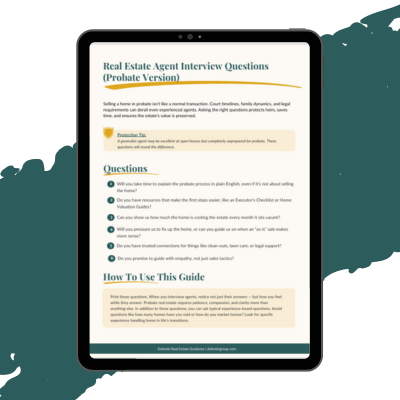
One wrong hire can cost heirs thousands
Most agents will say “yes” to anything — but only the right probate realtor can back it up. Get the Interview Questions PDF and know what to ask before you sign.
Pricing, Speed, and the Probate Perspective
When sitting down with various real estate agents, it is easy to lose sight of the bigger picture. Most real estate agents will try to draw your attention to the transaction. The sale.
They will distract your eye from the fact that real estate is part of a larger process — probate.
Agents will tell you what sets them apart is marketing — fancier flyers, more social media posts, or bigger ad budgets. The truth? Today’s market is a level playing field. Sites like Zillow, Realtor.com, and MLS syndication ensure every listing gets wide exposure.
What really matters when selling a probate home is pricing, process, and speed. The right price and process attracts buyers quickly, protects against drawn-out carrying costs, and ensures the estate nets the most value.
You see, probate homes live on a continuum between price and speed. You can wait and try to optimize for every last dollar, but the estate pays for that wait through carrying costs, creditor pressure, and family stress.
Or, you can price with precision, move quickly, and often net more simply because you avoided months of unnecessary expenses.
Value, Not Just Cost
Families often compare fees side by side: “That attorney charges $3,500, but I could fill out the forms myself.” Or, “That realtor wants 7%, but another agent could list the house for 6% or even FSBO.”
The right professionals don’t just handle tasks — they protect the estate’s efficiency and net outcome. In probate, saving money on the front end can easily cost multiples more on the back end.
But probate isn’t a straight cost comparison — it’s a calculation of efficiency. The right professional often reduces overall costs by shortening timelines, avoiding errors, and preventing disputes.
Select The Right Offer
Price matters, but terms determine speed and certainty.
Favor strong proof of funds, meaningful earnest money, short inspections with caps, appraisal gap coverage where appropriate, and a close date that aligns to your probate milestones.
Add a brief post-close occupancy if the family needs time to finish cleanout—buyers who fit your timeline often net you more than slightly higher prices with messy contingencies.
You should prioritize cash and conventional loan offers over FHA and VA. Cash and conventional loans do not have as many lending requirements as FHA and VA loans.
The FHA and VA loans will often require the home to meet a certain condition. As a result, many probate homes cannot pass the lending requirements and deals may fall through or sellers are forced to make repairs.
How Long Will It Take To Sell My Probate Home?
Families often ask how long it will take to sell the probate home. The honest answer is that the sale isn’t just tied to the property itself—it’s tied to the probate process, market conditions, and the strategy the estate chooses.
The Probate Timeline Matters Most
In Michigan, probate cases must remain open at least four months to allow creditors to file claims, and many estates take closer to 8–12 months to close. A home can only be sold once the personal representative has been granted authority. That means listing too early—before probate paperwork is in order—can cause delays or even nullify a contract.
The exact length of probate will depend on the complexity of the overall estate and family dynamics.
Pricing Shapes Speed
Pricing is the single biggest factor in how fast a probate home sells. Homes priced right for their condition and location attract buyers quickly—even in probate. Overpricing, on the other hand, leads to months of extra carrying costs, higher risk of price reductions, and frustrated heirs.
📊 Estate Snapshot: A home listed $15,000 too high may take three extra months to sell. At $1,000 a month in carrying costs, that “high price” strategy actually costs the estate $3,000 more than pricing it correctly from the start.
Market Conditions Set the Stage
The broader real estate market also plays a role. In a hot seller’s market, homes move in days or weeks. In a slower market, buyers have more leverage and sales may stretch out.
The key is for the estate to respond realistically to market data—leaning on appraisers, Pricing Strategy Advisors (PSAs), and experienced probate realtors for accurate guidance.
Managing The Home While Listed
Once the home is listed, the estate will still have bills coming in. Depending on the home, you may have mortgage costs, property taxes, insurance premiums, and utility costs while the home is listed.
In addition, you will need to make sure the lawn is cared for, snow is removed, and you’re keeping up with the basics of the property.
Every month the property remains unsold adds to the estate’s expenses—and those costs directly reduce what heirs receive. For this reason, these costs can be referred to as the burn rate.
You can calculate your burn rate by taking the monthly expenses associated with the home and see how much money is burned or lost every month the home sits unsold or probate is left open.
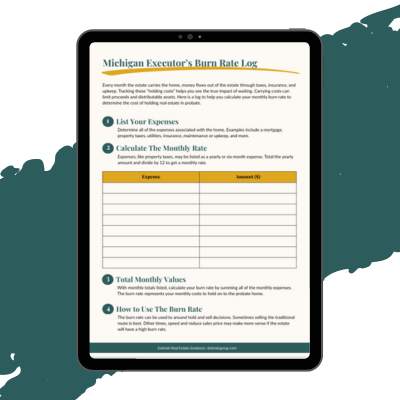
See What Waiting Really Costs
Carrying costs can eat away at the estate. Use the burn rate to see what holding the home costs.
This is why pricing matters more than marketing flash. The longer a home sits unsold, the more it eats into the estate’s net proceeds. In probate, protecting value often means prioritizing speed and certainty over chasing the perfect number.
In an ideal world, these expenses are paid for by the estate. Sometimes, there is not enough cash in the estate even after liquidating some of the assets, such as a car or stocks. In this case, the cash may come from the executor or heirs (though not required).
The 7/14/21 Rule for Pricing
An executor should review data on day 7 and 14. Look at showings and serious offers. By day 14, you should expect at least one offer for every eight to ten showings.
If no serious offers, a price adjustment is likely needed. By day 21, the listing is starting to “stale” online and a price adjustment is likely needed to reengage and interest new buyers.
After a price adjustment, repeat the same 7/14/21 day rule. Planned price corrections beat reactive ones and usually reduce burn rate.
Selling A Probate Home For Executors Out-of-State
Probate is challenging enough when you live nearby. Add hundreds or even thousands of miles, and the complexity multiplies. Many executors or heirs live in another state when a Michigan home enters probate.
Distance can increase costs and cause delays — from carrying costs, to limited property oversight, to travel expenses.
As a result, mistakes in probate are amplified when managing an estate from a far distance. You need to build the right team on the ground near where the home is located.
At least living by the property, executors can limit some of the mistakes or save money, for example, by caring for the property themselves.
You can read more about our guide on selling out-of-state.
What if the probate estate is in Michigan, but the real estate is in Florida?
This is a common situation for Michigan families with Florida snowbird properties.
Probate is generally handled in the state where the person was legally domiciled at death, but real estate is governed by the laws of the state where the property is located.
That often means a Michigan probate estate may still require additional legal steps to sell a Florida property (or the reverse), such as ancillary probate or coordination with a local attorney in the other state.
From a real estate standpoint, this adds timing, documentation, and coordination considerations, especially if executors or heirs live out of state.
In these cases, it’s important to work with professionals who understand multi-state estates and can coordinate between attorneys, title companies, and local market conditions to avoid delays or costly mistakes.
What To Do With Estate Proceeds?
When the probate home is finally sold, the estate will hold liquid funds instead of a property. What happens next depends on the estate plan, the will, and Michigan probate law—but from a financial and family perspective, what really matters is how those proceeds are used and protected.
For many heirs, this is the first time in their lives they’ve received a lump sum inheritance. The temptation is often to spend quickly, but there’s an opportunity here to think long-term. Estate proceeds can:
- Pay off outstanding debts so heirs gain financial breathing room.
- Create savings or investment accounts that carry the legacy forward.
- Fund education, caregiving, or future housing needs in ways that honor the loved one’s memory.
- Be reinvested into real estate—whether that’s a first home, a rental property, or another wealth-building asset.
The goal is to recognize that proceeds aren’t just cash. They’re the transformed value of a lifetime of work, discipline, and sacrifice. Using them wisely honors the legacy behind the home more than any upgrade or sale strategy ever could.
What if the property is owned by a trust?
If the home is owned by a trust, the process for selling it is often simpler — but the responsibility is higher.
When a trustor passes away or becomes incapacitated, the trustee typically has authority to sell the property according to the trust’s terms.
In many cases, this allows the sale to bypass probate. However, unlike an heir selling property they already own outright, a trustee is acting in a fiduciary role.
That means the trustee has a legal duty to act in the best interest of the beneficiaries, document decisions, and demonstrate that the sale was handled fairly and responsibly. Pricing, timing, repairs, and sale methods are not just personal choices — they are decisions that must withstand beneficiary scrutiny.
From a practical standpoint, selling a trust-owned home looks similar to selling a probate property: the home must be valued appropriately, prepared responsibly, and sold using a clear strategy.
If you are selling as a trustee or executor, transparency and documentation matter far more than speed or convenience. If you are selling after the property has already been distributed to you as an heir, those fiduciary obligations typically no longer apply.
If you’re unsure whether a home is still held in trust or what authority applies, an estate or probate attorney can help clarify before the sale moves forward.
Seller Disclosures During Probate (Michigan)
When a home is sold as part of an active probate estate, Michigan law treats disclosures differently than a typical residential sale.
Under MCL 565.953, sales conducted by a non-occupant fiduciary — such as a personal representative or executor acting under court authority — are generally exempt from Michigan’s standard seller disclosure requirements.
This exemption exists because executors often did not live in the home and cannot reasonably attest to its condition.
That said, the exemption is not automatic in every scenario.
Disclosure obligations can change if:
- the executor or a beneficiary occupied the property,
- repairs or improvements were made during administration,
- the property transfers out of the estate before sale,
- or the sale structure falls outside court-authorized administration.
Because executors have fiduciary duties to both the court and the heirs, the safest approach is not to assume exemption — but to confirm how disclosures apply to the estate’s specific situation.
Understanding this early helps executors reduce liability, avoid delays, and document decisions appropriately as part of the probate record.
Conclusion: Protecting Value, Preserving Legacy
Selling a home in probate is unlike any other transaction. It isn’t just about dollars and paperwork—it’s about carrying forward a lifetime of work, memories, and legacy while making sure heirs receive the value that’s rightfully theirs.
The difference between a smooth process and a costly one often comes down to the right guidance. Pricing decisions, timelines, carrying costs, family dynamics—these aren’t details to leave to chance. They’re the very factors that determine whether the estate keeps more or loses more.
At Dolinski, we specialize in this intersection of real estate and probate. We don’t just list homes—we protect estates. We step in as the steady hand when families need clarity, efficiency, and compassion the most.
Work With Dolinski
If you’re navigating probate in Michigan and need to decide what to do with the family home, we can help:
-
- Probate Expertise: We’ve guided families through every scenario—selling as-is, managing repairs, evaluating cash offers, and coordinating from out of state.
- Net-Focused Strategy: Our approach looks beyond sale price to protect what heirs actually receive after costs, carrying expenses, and risks.
- Compassionate Guidance: We understand these aren’t just houses. They’re homes, full of memories. We honor that while making sure the process moves forward with efficiency and respect.